Popular Posts

06 January 2014

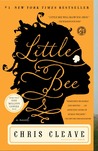
Book Review: Little Bee


Little BeeLittle Bee by Chris Cleave
My rating: 3 of 5 stars

The back cover blurb claims that the magic of this story is not what happens, but how the story unfolds.  I disagree.  I think the magic is not in the story or the plot.  The magic is in the moments, the small worlds within the larger world of the novel, that Cleave creates with his prose.

Cleave paints a complex tale of interior conflict arising from a tale of exterior conflict.  And while the exterior conflict of Cleave's characters is intense, dramatic and highly political, the interior conflict is what drives the book forward. The politics of Cleave's book become secondary because Cleave chooses interior over exterior.  He studiously avoids painting the blatant swath of a morality tale; instead, he invests in the smaller story that trickles out like a tributary from a powerful river.

And somehow when Cleave, a white, privileged male, channels a black, African teenage girl, he is at his best.  When he puts himself into her world and her thoughts, his prose resonates with meaning and thoughtfulness;

"I ask you right here please to agree with me that a scar is never ugly.  That is what the scar makers want us to think.  But you and I, we must make an agreement to defy them.  We must see all scars as beauty. Okay? This will be our secret.  Because take it from me, a scar does not form on the dying.  A scar means, I survived."

"This was always my trouble when I was learning to speak your language.  Every word can defend itself.  Just when you go to grab it, it can split into two separate meanings so the understanding closes on empty air.  I admire you people.  You are like sorcerers and you have made your language as safe as your money."

"In your country, if you are not scared enough already, you can go to watch a horror film.  Afterward, you can go out of the cinema into the night and for a little while there is horror in everything...For one hour you are haunted, and you do not trust anybody, and then the feeling fades away.  Horror in your country is something you take a dose of to remind yourself that you are not suffering from it."

"I do not know why the small puddle of urine made me start to cry.  I do not know why the mind chooses these small things to break itself on."

Cleave doesn't do as well with the white Brits of his tale, though there are a few moments;

"I'm so sorry, Charlie.  Mummy is too grown up to feel very much anymore, and so when she does, it catches her by surprise."

"There's eight million people here pretending the others aren't getting on their nerves.  I believe it's called civilization."

But despite the gorgeous prose Little Bee was somewhat of a disappointment.  Look past some of the more beautiful writing and it becomes simply the story of three unlikeable adults, one loosely-drawn and mostly annoying child and a girl who we only get a chance to know through her story of personal tragedy.  Add a nebulous ending and you get one of those books that you finish and throw aside in disgust.  But you aren't sorry you read it.  And parts of it stick with you long after you've returned it to the shelf.


View all my reviews

Book Review: Eighty Days


Eighty Days: Nellie Bly and Elizabeth Bisland's History-Making Race Around the WorldEighty Days: Nellie Bly and Elizabeth Bisland's History-Making Race Around the World by Matthew Goodman
My rating: 4 of 5 stars

I love history books that expand outside the main story and provide tangents to enrich my reading experience AND give me random trivia to blurt out in a Cliff Clavin-like way.  This is one of those books.  The original story was intriguing to me, as I had never heard of the race between these two women, but then Goodman adds things like;

The Statue of Liberty was originally supposed to stand at the mouth of the Suez Canal, dressed in the veil and dress of an Egyptian peasant, holding a lantern, representing the light of Egypt bringing progress to Asia.  But Egypt's leaders thought it was too expensive, so it was re-imagined as liberty and shoveled off to the US.  But it was too expensive for us, too;  Congress refused to allocate funds to build a pedestal.  So the centennial came and went and Lady Liberty was sitting in a warehouse somewhere.  They put her right arm outside Madison Square Park to try to bring attention to her plight.  It was there for 7 years and the money was still not raised.  Finally, Joseph Pulitzer issued a personal appeal for funds in the pages of his paper, The World and the paper's working class readers, sent pennies and nickels.  Five months later, the 100k needed was raised, 80% from donations of less than a dollar.  And Lady Liberty took her place in the harbor.  Crowd-funding before the word existed.

Did you know until the latter decades of the 19th century, communities had the power to establish their own time zones?  Local mean time, they called it, determined by the position of the sun as it passed overhead.  Illinois had 27 different time zones, Wisconsin, 38.  The train station in Pittsburgh had six clocks and each one showed a different time.  When it was noon in Washington, D.C., it was 12:08 in Philadelphia, 12:12 in New York and 12:24 in Boston.  Of course, trains that could traverse a mile a minute made local mean time untenable.  So in October 1883, the largest railroad companies had meeting and declared that the country would be divided into four time zones, corresponding to the mean sun time at the meridians near Philadelphia, Memphis, Denver and Fresno. The president, the Congress and the courts had nothing to do with it but it became the law of the land.  On November 18, 1883, clocks were changed.

Otherwise, this book highlighted the amazing strides in travel in only 120 years.  Elizabeth Bisland believed that humans were not made to travel a mile a minute.  "She wondered how coming generations, who would surely travel one hundred or even one hundred fifty miles and hour, could possibly handle the strain of it.  Some process of adaptation to the new environment would doubtless take place: humanity, it seemed, always found a way to bear what had previously seemed unbearable."  What would she think now?

And Nellie Bly despised the British (whose transport she was forced to use as they had developed it in pursuit of their empire)  Goodman writes, "As she traveled among the English, Nellie Bly was becoming increasingly conscious of the peculiar privilege that imperial power conferred upon its citizens; the privilege of insensitivity.  They could, if they chose to, carry the empire along with them on their travels, as they sailed on English ships, slept in English hotels, ate English meals, taking little notice of the specific characteristics of the countries through which they passed..."  Huh.  That's exactly the complaint I have about American tourists now.  And cruise ships.  And tour buses, that allow people to wander through a country without having to touch, smell or taste it.  The more things change...

In 1910, Elizabeth Bisland returned to Japan with her husband.  She was looking "for the Japan of the Japanese, 'light, fine, frail, with a touch of whimsey; of gay fancifulness; of soft delicate fairness and flowery quiet.'  That Japan, though, was becoming increasingly difficult to find; the new trains brought swarms of tourists, and the streets were lined with the modern hotels and teahouses that catered to them. 'One wouldn't begrudge the tourist so if he seemed to enjoy it, but his perspiring pervasiveness apparently derives nothing but fatigue from the effort, and one can't but wish he'd leave the places of beauty alone to the few who do get comfort out of them.'" Bisland considered the world "utterly destroyed by our loathsome Occidental 'improvements.'"

And as the ladies traveled, they asked questions like, "Why do Chinese women bind their feet?" only to receive the non-answer, "Why do European women wear corsets and pinch their waists?"  World travel makes you question your own fashion, customs and ideas in ways that these women had never had the chance to experience.  In our internet-laden present, the world is smaller.  But are we paying attention the way these wide-eyed, intellectually curious ladies did in the late 1800s?  Or has the world shrunk so much and become so universal (with our loathsome Occidental improvements) that the common ground has overtaken the differences?


View all my reviews

19 September 2013

Book Review; A Whole New Mind


A Whole New Mind: Why Right-Brainers Will Rule the FutureA Whole New Mind: Why Right-Brainers Will Rule the Future by Daniel H. Pink
My rating: 3 of 5 stars

Despite the fact that every time I saw the cover of this book, the song "A Whole New World" from Aladdin was stuck in my head for hours, I still kind of enjoyed this book.

And the "kind of" has reasons beyond annoying earworms.  Pink's thesis is this; we are transitioning from an Information Age economy to a Conceptual Age economy.  So we'd best get ready.

"For nearly a century, Western society in general, and American society in particular, has been dominated by a form of thinking and an approach to life that is narrowly reductive and deeply analytical.  Ours has been the age of the 'knowledge worker,' the well-educated manipulator of information and deployer of expertise.  But that is changing.  Thanks to an array of forces--material abundance that is deepening our nonmaterial yearnings, globalization that is shipping white-collar work overseas, and powerful technologies that are eliminating certain kinds of work altogether--we are entering a new age.  It is an age animated by a different form of thinking and a new approach to life--one that prizes aptitudes that I call 'high concept' and 'high touch.'  High concept involves the capacity to detect patterns and opportunities, to create artistic and emotional beauty, to craft a satisfying narrative, and to combine seemingly unrelated ideas into something new.  High touch involves the ability to empathize with others, to understand the subtleties of human interaction, to find joy in one's self and to elicit it in others, and to stretch beyond the quotidian in pursuit of purpose and meaning."

Phew.  But that's the book.  Then Pink spends the next 250 pages over-explaining himself and gazing at his navel.  Pink tries to avoid the overused terms "right brain" and "left brain" but ends up with the equally divisive terms "R-Directed Thinking" and "L-Directed Thinking" in his quest to demonstrate that we're moving into a world where creativity will increasingly make logic take a back seat. Pink is not predicting a world where "millionaire potters drive BMWs and computer programmers scrub counters at Chick-fil-A."  Pink goes ont to say, "L-Directed Thinking remains indispensable.  It's just no longer sufficient.  In the Conceptual Age, what we need instead is a whole new mind. (cue music from Aladdin)

Pink then presents the reader with "tools" to develop the "six senses" Pink believes will be the most in demand as we move into this age; Design, Story, Symphony, Empathy, Play and Meaning.

Design; people heal faster and work more productively in hospitals and offices that demonstrate thoughtful aesthetics of design.

Now that facts are so widely available and instantly accessible, they are not as valuable as they used to be.  Computers will always be faster at gathering and organizing information, so what becomes valuable is someone, a real, live, person, who can make sense of the facts.  Story; stringing those facts together in a context that has emotional impact.  Symphony; putting the facts together in a way that makes them stronger and more persuasive.  Empathy; one thing computers cannot do, and will probably never be able to do, is demonstrate empathy. Play; a move away from sober seriousness as a measure of ability.  Meaning; people have enough to live, but nothing to live for--we must find a way to find meaning.

So, really, this book is about the fact that being human is going to be increasingly valuable and we should embrace our human-ness.  We've spent the last fifty years trying to be more like the machines but as the machines have progressed, we can't keep up.  So we're left with making a point of being different than the machines; providing something the machines cannot.  Pink's six traits are human traits that have been suppressed during the Information Age.  They are now ready for a renaissance.

Why did I just "kind of" like this book?  Pink provides a chapter on the six senses and then a "portfolio" to improve on those six senses.  Ugh.  I can just see stick-in-the-mud middle managers creating business meetings and retreats, replete with forced games and powerpoint presentations, designed to increase capacity for these six senses based on Pink's portfolios.  They would be following Pink's advice to the tee but totally missing the point AND the mark.  David Collison writes, "Attempts to manufacture humor can actually suppress it..."  I would submit that attempts to manufacture ANY of these six senses will, in effect, suppress them.  As soon as my boss tells me I HAVE to be funny, I probably won't really be able to be funny anymore.  What organizations need to do is find people who have these skills in abundance already.  And then let those skills start to change their organizations.

I may be delusional, but I think I have most of these traits and bring them to my work.  Let's take "play," for example.  I cannot count the number of times I've been in trouble at work for laughing and showing joy. Just yesterday, a coworker said, "Don't let the others know you're having fun."  Why not?  I was doing the work; I just found a way to make it enjoyable for myself and the other two coworkers with whom I was collaborating.  Is fun inherently bad?   Not according to Pink.  He cites research that found that the most effective leaders within organizations are funny and had their charges laughing three times more often than their managerial counterparts.  Score!  I'm funny!  I win!  Yay me!   But Pink's book is now almost 10 years old and we're still mired in L-Directed Thinking; yesterday's encounter proves it.

So make your middle managers read this book.  It is unlikely that they will be able to change and suddenly embrace these senses and embody them authentically.   And that's ok.  But they they are in a position to change their departments, and the larger organization, by restructuring the human make-up of the employees who work for them.  Organizations should keep, and value, effective L-Directed thinkers.  We need them.  But we also need poets and musicians and actors and artists.  They won't alway fit in.  Or wear proper business attire.  Or be serious.  They won't always be brilliant.  Or have life-changing ideas.  They may not always be inspiring.  Hire them anyway.  And watch how the culture changes.


View all my reviews
16 September 2013

Book Review: The War Lovers


The War Lovers: Roosevelt, Lodge, Hearst, and the Rush to Empire, 1898The War Lovers: Roosevelt, Lodge, Hearst, and the Rush to Empire, 1898 by Evan Thomas
My rating: 3 of 5 stars

Would we have gone to war in Cuba without Hearst, Roosevelt and Lodge?

Would we have gone to war in Iraq without Cheney, Rumsfeld and Murdoch?

The more things change, the more they stay the same.  Thomas' thesis is that worries about the weakening of the Anglo-Saxon race, combined with the rise of strong women, created a generation of men with free-floating anxiety and angst that was only cured by strenuous exercise and war-lust.

That was in 1898.  But read it again.  Could be now, couldn't it?  Cross-fit and Afghanistan.

Thomas' book concentrates on a select few figures, one of which is philosopher William James.  James, who taught at Harvard (taught Roosevelt and Lodge, in fact) had the "good sense, and the rare judgement, to see through the social Darwinists."  James was not "free of the prejudices of his age, but he was unusually--among his fellow academics, almost uniquely--open to the idea that different races had different qualities, and that one should learn from them, and not simply judge."

Outside of James, the prevalent teaching was Anglo-Saxon superiority, which requires the parallel belief of All-Other-Race inferiority.  W.E.B. DuBois studied with James.  Roosevelt was more partial to a man named Norman Shaler, a social Darwinist who worried that "alien races" would water down good American stock.

On the surface, Shaler paired fighting for the independence of the dark-skinned Cubans seems oxymoronic.  Just as the strenuous exercise and war-lust paired with the prevalence of nervous exhaustion seems so.  But logic is rarely a driving force in history.

Take the sinking of the Maine, one of the reasons the US sent troops to Cuba.  The ship blew up.  Logical minds thought, "Accident," because the coal bunker was right next to the gunpowder magazine.  But Hearst ignored logic, stirred up conspiracy, ignored facts and presented the kind of news that is less news and more fodder for advertising dollars and sales.

And then there's Spain, who knew they would lose a war with America but felt the need to fight one anyway because of a concept called punctilio: better to be defeated than to be seen backing down (at one point, they even fought a fake battle, but got confused and people died anyway)

By the time the first shots were fired, the war was actually mostly over but it led to a quagmire in the Phillippines, which Korea and Vietnam echoed a half-a-century later.  And the question of how Cuba would govern itself has multiple echoes in the 20th century.

Those who don't know history are doomed to repeat it. --  Edmund Burke

Between the idea
And the reality
Between the motion
And the act
Falls the shadow

T.S. Eliot


View all my reviews

04 September 2013

Book Review: Ike and Dick


Ike and Dick: Portrait of a Strange Political MarriageIke and Dick: Portrait of a Strange Political Marriage by Jeffrey Frank
My rating: 2 of 5 stars

I think this book should have a different title; perhaps something like

"Dick! (with a sprinkling of Ike)"

But the imbalance doesn't even bother me in light of my other concerns about this dual biography.

Though I know very little about these two men, I don't feel all that enlightened after reading this book.  Frank seems to be balancing on a line between too much and too little information and, for me, he never quite got it right.  He assumed I knew things I didn't.  He barely mentioned things I wanted to know more about.  He repeated things I didn't really care about.  And, worst of all, for me, he put words and thoughts into both of these historical figures mouths.

This is Frank's description of Nixon while Eisenhower was lying in state: "Nixon's military aide, Don Hughes, was sitting close to the president and saw that as he left the Rotunda he broke down again.  It is hard, though, to imagine those were tears of grief.  They are better explained by Nixon's continuing sadness at never having been admitted to the general's small, rarely expanded circle, the one that he reserved for friends."

How the hell do you know that, Mr. Frank?  Why would you presume to assume something and then declare it as fact?  Did you make an executive decision based on your research?  If so, why not tell me why you think that?

The book is filled with moments such as this, weakening an already weak history.

Frank makes Eisenhower into a passive-aggressive flip-flopper who is so eminently unlikeable that you wonder why Nixon continued to work so hard to seek his approval.  Nixon is gruff and too driven and seems to lose his mind before he's elected president (one of those things I found worthy of more exploration but which Frank glosses over, like most other interesting story lines).

I came away from this book completely disinterested in the both of them.  Which is unfortunate.  Because I still think that, handled better, these two men, and their era, could be fascinating.


View all my reviews


30 August 2013

Book Review: Then We Came to the End


Then We Came to the EndThen We Came to the End by Joshua Ferris
My rating: 3 of 5 stars

The whole time I was reading this book, I felt like a weird hanger-on gossip.  I didn't like any of these people.  But I kept reading about them.  Like I would have kept listening to Benny gossip about them if I worked in this  office peopled with such off-center characters.  Ferris narrates but his character is never defined.  Never says anything.  Never even really expresses an opinion.  He's a ghost.  He's the intern that no one pays attention to but who writes the revealing novel later.

Then I came to the end and Ferris wrote, "We were the only two left.  Just the two of us, you and me."

Dammit!  He made me complicit in his seedy little world of corporate ridiculousness.  With two sentences, he transformed me from an observer to a participant.  And then I had to wonder; if I had been there, would I have taken these people on as projects? Would I have tried to help them find a path towards something more meaningful or happy or comforting?  Probably not.  So I actually felt guilty for not trying to help these people, these fake people who are fake, but are real, too.  

And then he'd write stuff like this;

"There was so much unpleasantness in the workaday world.  The last thing you ever wanted to do at night was go home and do the dishes.  And just the idea that part of the weekend had to be dedicated to getting the oil changed and doing the laundry was enough to make those of us still full from lunch want to lie down in the hallway and force anyone dumb enough to remain committed to walk around us...But enough daydreaming.  Our desks were waiting, we had work to do.  And work was everything.  We liked to think it was family, it was God, it was following football on Sundays, it was shopping with the girls or a strong drink on Saturday night, that it was love, that it was sex, that it was keeping our eye on retirement.  But at two in the afternoon with bills to pay and layoffs hovering over us, it was all about the work."

"If in large part we were concerned only with making through another day without getting laid off, there was a smaller park just hoping to leave for the night without contributing to someone's lifetime of hurt."

"Maybe there was an alternative to wealth and success as the fulfillment of the American dream.  Or maybe that was the dream of a different nation, in some future world order, and we were stuck in the dark ages of luxury and comfort.  how could we be expected to break out of it, we who were overpaid, well-insured and bonanaza'd with credit, we who were untrained in the enlightened practice of putting ourselves second?"

Blergh.  I don't want to think about this in my spare time when I'm trying to reassure myself that my life is about more than my job.  I'm going back to reading history.


View all my reviews

Book Review: Berlin 1961


Berlin 1961Berlin 1961 by Frederick Kempe
My rating: 3 of 5 stars

I'll open this review with an admission of my ignorance.  I had no idea Berlin was located so deep in East Germany.  In my head, my whole life, Berlin sat on the border and the wall reflected that larger border.

So to find out (and probably not for the first time, but this was the first time it stuck) that Berlin was a strange island.  So then I kept thinking of the Vienna of The Third Man and wondering how many other places were so strangely divided.

Oh, the Cold War.  Such an odd moment in history.

Because most of the historical lessons of this book were new to me, I cannot speak with assurance on its accuracy or fairness.  Kempe does not think highly of Kennedy's handling in 1961 and, in reading this account, I'm amazed that history has been so kind to him (though he apparently redeemed himself in 1962)

My take-away is simple;  politics is filled with regular people acting poorly, misreading each other, gossiping, manipulating, lying, redefining truth and posturing.  It's like junior high but with a lot more at stake.


View all my reviews